
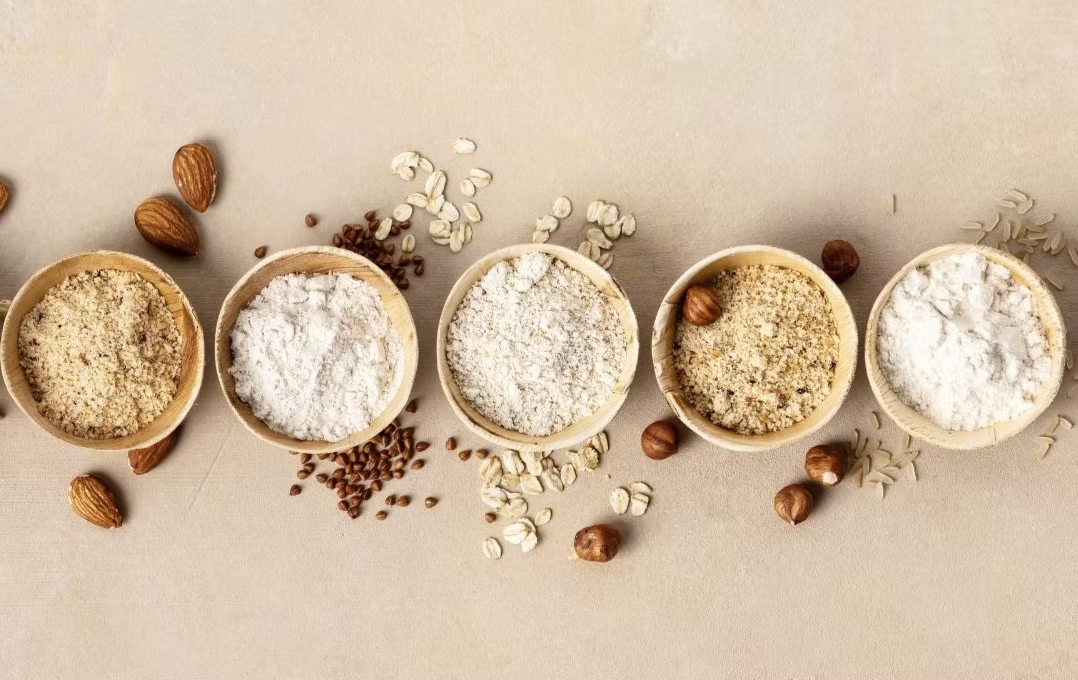
I’ve prepared a guide for you, my friends. I hope it will be a guide for everyone who has switched to a gluten-free diet, heard about it, wants to try it, or is curious about it. I’ve gathered all the grains and flours in one place. I’ve compared each one individually with regular wheat flour. Some brands may have different liquid absorption ratios; but generally, the consistency is more or less the same. I tried to explain it as concisely as possible. You really liked the version with sugar alternatives. I hope this one will be very useful to you too. The information is from my first book, Sema’s Healthy Kitchen 🙂
Following a gluten-free diet doesn’t mean using factory-made or man-made “gluten-free flours” obtained with starches and thickeners. Products sold on supermarket shelves under the name “gluten-free flour” contain high levels of starch; in fact, they do more harm than good. Usable gluten-free flours are those made from grains, nuts, seeds, and fruits that are naturally gluten-free.
Coconut Flour
My miracle flour. It’s so high in fiber that it absorbs liquids like a hose. This makes it very filling, helps balance insulin and blood sugar. It tastes amazing. It goes well with both sweet and savory dishes. Since coconut flour isn’t a grain, it’s naturally gluten-free.
Consistency ratio: 1 cup of regular wheat flour is equivalent to 3 tablespoons of coconut flour.
Buckwheat Flour
Although its name sounds confusing in Turkish, it’s actually not a type of wheat, but the seed of a plant. It’s also known as grechka. It’s usually sold roasted, and roasted buckwheat has a smoky taste and smell. I love this smoky taste and smell; but many people don’t. Therefore, those looking for a more neutral taste can opt for unroasted buckwheat or buckwheat flour.
Consistency Ratio: In recipes using regular wheat flour, it’s equivalent to a 1:1 ratio.
Quinoa Flour
Since quinoa isn’t a grain, it naturally falls into the gluten-free category. It can be used wherever rice and bulgur are used. Therefore, its flour is also in the gluten-free flour category.
Consistency Ratio: In recipes using regular wheat flour, it’s equivalent to a 1:1 ratio.
Rice
Rice is also naturally a gluten-free grain. All types of rice—brown, black, red, and other types of rice—that are not refined/white rice are suitable for a gluten-free diet. Since flour has a very high glycemic index, I recommend not using it excessively.
Almond Flour or Nut Flours
Flours made by grinding almonds or hazelnuts in a food processor are also gluten-free; however, it’s beneficial to use these types of flours more carefully due to their fat content and high calories. To avoid damaging the beneficial fats within them, cooking temperatures should not exceed 150 degrees Celsius. The beneficial fats in nuts are destroyed at high temperatures. This is why it’s often said that we should always eat nuts raw. From roasted nuts, instead of benefiting from them, we only get high calories and altered fats.
Oatmeal or Oat Flour
Oatmeal is naturally gluten-free; however, due to the processing it undergoes in the fields where it is produced and during packaging, and because wheat and wheat products are often found in the same areas, it is one of the foods with a high risk of cross-contamination. If you are concerned about gluten transmission, it is possible to find specially produced, gluten-free certified oatmeal on the market. If you have celiac disease or an autoimmune disease, you can purchase certified gluten-free oatmeal.
Consistency Ratio: Oat flour is equivalent to 3/4 of regular wheat flour in recipes using regular wheat flour; that is, you can use 3/4 cup of oat flour instead of 1 cup of regular flour.
Legume Flours
Since legumes are also inherently gluten-free, their flours are automatically gluten-free as well. These can include chickpea flour, bean flour, lentil flour, and so on. Chickpea flour is generally the most commonly used. I still prefer and recommend eating legumes as they are, in whole form. Because everything that becomes flour has a higher glycemic index. However, instead of using regular refined flour, I prefer legume flours, even though their glycemic index is slightly higher.
Consistency Ratio: Chickpea flour absorbs a lot of liquid. In recipes using regular wheat flour, the ratio is 1:1/2. For example, instead of 1 cup of regular flour, 1/2 cup of chickpea flour is sufficient. For dried bean and lentil flour, this ratio is 1:3/4.
Sorghum Flour
One of the newer flours we have. It’s locally produced. Its texture is slightly grainy, like corn flour. It’s a neutral-tasting flour; it goes well with sweet, savory, and everything else, but it has a high glycemic index and carbohydrate content. I will use it less often. I generally use it to make breading for vegetables or mix it with other flours.
Consistency ratio: Sorghum flour is equivalent to regular wheat flour in a 1:1 ratio in recipes using regular wheat flour; that is, you can use 1 cup of sorghum flour instead of 1 cup of regular wheat flour. An egg is needed to bind the mixture.
I hope this information helps you.
With love to everyone,
Sema